Page 1 of 2 12 LastLast
Results 1 to 30 of 40

Thread: Half of all food produced in the US is thrown away?

  1. #1

    Default Half of all food produced in the US is thrown away?

    https://www.theguardian.com/environm...tables-perfect

    Somewhat exaggerated but holy crap.

    I don't really buy the stuff about world hunger but that's just plain fucked up. What a waste. And what a weird species we are. If I'm not mistaken this obsession with blemish-free food is partly to blame for the frequently tasteless supermarket vegetables we're forced to endure.

    I dunno, either way, this is just spectacularly wasteful even if you can find ways to explain it.
    "One day, we shall die. All the other days, we shall live."

  2. #2
    Meh not entirely. It can be more efficient to produce in bulk and then get rid of substandard than it is to produce less. Modern farming is very efficient, to a scale historically unimaginable.
    Quote Originally Posted by Ominous Gamer View Post
    ℬeing upset is understandable, but be upset at yourself for poor planning, not at the world by acting like a spoiled bitch during an interview.

  3. #3
    One thing that's messed up is the way things are determined to be "substandard" but I guess people have grown accustomed to their flawless tomatoes despite their substandard flavour.
    "One day, we shall die. All the other days, we shall live."

  4. #4
    I buy so-called "wonky veg" from my supermarket, it's cheaper and misshapen but just as good quality.
    Quote Originally Posted by Ominous Gamer View Post
    ℬeing upset is understandable, but be upset at yourself for poor planning, not at the world by acting like a spoiled bitch during an interview.

  5. #5
    As the article mentions, that kinda thing has become more common in some places and been given an image-makeover:


    And yet
    "One day, we shall die. All the other days, we shall live."

  6. #6
    Quote Originally Posted by RandBlade View Post
    Meh not entirely. It can be more efficient to produce in bulk and then get rid of substandard than it is to produce less. Modern farming is very efficient, to a scale historically unimaginable.
    For some produce, it's also easy to use visually substandard fruit for e.g. processed foods where the original appearance is irrelevant. Doesn't work for all fruits and veggies, though, since some of them aren't used a lot in such applications. Also possible to use some lower grade produce for e.g. livestock feed, though again that's dependent on some details.

    The bigger issue IMO has less to do with wastage at farms but with wastage by stores and by consumers. There's a lot of space here for improvement, especially by consumers (retailers are in a bit of a bind because they have to forecast demand, meaning they typically want some buffer of wastage rather than empty shelves). There are also some fixes here - donating produce to nearby food pantrys/shelters/etc. before they go bad, composting (by consumers) to salvage something from rotten food, etc. But we have to recognize that the US food distribution system is large and complex, and assuring that every paying customer has ready access to a wide variety of foods is not without its overhead. It's astonishing to see how food distribution in the US has changed even in the last few decades - now, you can get most produce year round (with some notable exceptions), even if off-season or non-local produce is pricier and rarely as tasty. This is relatively new for the US, and is not fully replicated even in other parts of the developed world. There are advantages to this, of course, but there are also costs - environmental, financial, etc.
    "When I meet God, I am going to ask him two questions: Why relativity? And why turbulence? I really believe he will have an answer for the first." - Werner Heisenberg (maybe)

  7. #7
    It can be more efficient for supermarkets to buy more food than get just enough, but it can also be more efficient for customers to buy more food than they need.

    It is for instance cheaper for instance for me to get a new bag each of mushrooms, onions, tomatoes etc delivered each week in my weekly shop and throw away any waste than it is to make more than one shop a week.
    Quote Originally Posted by Ominous Gamer View Post
    ℬeing upset is understandable, but be upset at yourself for poor planning, not at the world by acting like a spoiled bitch during an interview.

  8. #8
    Curious why supermarkets can't adopt a better-integrated model that lets them order only as much food as they think they'll sell and then have a mechanism for rapidly getting extra food if they're wrong.
    Hope is the denial of reality

  9. #9
    Quote Originally Posted by Loki View Post
    ...and then have a mechanism for rapidly getting extra food if they're wrong.
    How? Last time I checked, teleportation wasn't invented yet.

    What I wonder, if the food is actually is thrown away (landfill or sink) or recycled (compost or feed). I still think food
    "Wer Visionen hat, sollte zum Arzt gehen." - Helmut Schmidt

  10. #10
    Quote Originally Posted by earthJoker View Post
    How? Last time I checked, teleportation wasn't invented yet.

    What I wonder, if the food is actually is thrown away (landfill or sink) or recycled (compost or feed). I still think food
    Amazon does it. Wal-Mart does it for certain kinds of products. You could have some kind of a temporary warehouse. It could even make economic sense in major cities.

    The hunger issue is irrelevant because the main problem in that part of the world is distribution, not existence of food. The bigger issue is the massive waste of energy in producing this food.
    Hope is the denial of reality

  11. #11
    Quote Originally Posted by Loki View Post
    Amazon does it. Wal-Mart does it for certain kinds of products. You could have some kind of a temporary warehouse. It could even make economic sense in major cities.
    I don't know where you currently live, but here we have some traffic. It just doesn't make sense to deliver fresh products more than once a day, and that is what is already done.
    "Wer Visionen hat, sollte zum Arzt gehen." - Helmut Schmidt

  12. #12
    Let sleeping tigers lie Khendraja'aro's Avatar
    Join Date
    Jan 2010
    Location
    In the forests of the night
    Posts
    6,239
    Quote Originally Posted by Loki View Post
    Curious why supermarkets can't adopt a better-integrated model that lets them order only as much food as they think they'll sell and then have a mechanism for rapidly getting extra food if they're wrong.
    Half-empty shelves don't sell, Loki. If a shelve has, say, only one or two fruit left those fruits will rarely be sold. Even when they're perfectly fine - it's just that because they're the last ones that people think there's something wrong with them.
    When the stars threw down their spears
    And watered heaven with their tears:
    Did he smile his work to see?
    Did he who made the lamb make thee?

  13. #13
    Overall, it looks like around half of the food wastage in NA occurs upstream (up to and including postharvest handling and storage; slightly less in Europe) compared to about two thirds in the poorest countries.

    In Europe, most of the downstream wastage occurs at the consumption stage while in NA it's fairly evenly split between processing, distribution and consumption. Considerably less wastage in Europe during processing and distribution. If this is correct, then altering consumer behavior would seem to be the most promising path in yurp, even though people are crazy.

    Quote Originally Posted by Khendraja'aro View Post
    Half-empty shelves don't sell, Loki. If a shelve has, say, only one or two fruit left those fruits will rarely be sold. Even when they're perfectly fine - it's just that because they're the last ones that people think there's something wrong with them.
    This is only true for fruits though, you see the opposite effect with arguments for leaving the EU
    "One day, we shall die. All the other days, we shall live."

  14. #14
    Quote Originally Posted by Khendraja'aro View Post
    Half-empty shelves don't sell, Loki. If a shelve has, say, only one or two fruit left those fruits will rarely be sold. Even when they're perfectly fine - it's just that because they're the last ones that people think there's something wrong with them.
    That some how doesn't work for bread. My favorite is sold out all the time
    "Wer Visionen hat, sollte zum Arzt gehen." - Helmut Schmidt

  15. #15
    Senior Member
    Join Date
    Jan 2010
    Location
    Amsterdam/Istanbul
    Posts
    12,462
    I was wondering, are portion sizes not part of the problem here?
    Congratulations America

  16. #16
    Quote Originally Posted by earthJoker View Post
    I don't know where you currently live, but here we have some traffic. It just doesn't make sense to deliver fresh products more than once a day, and that is what is already done.
    Actually for some items I'm sure that my big grocery stores aren't restocked on a daily basis - they reshelve items from the back, yes, but the quality of produce changes noticeably throughout the week (I think the best quality tends to be Wednesday-ish). I would imagine that it's rather complex on which items are restocked when - probably has to do with regional distribution as well as 'granularity' - i.e. little point in shipping a refrigerated truck half-full. Smaller stores probably do more 'just in time' kind of stuff (likely at substantial additional cost) but I would imagine we'd need to talk to some grocery store logistics experts to get the full story. And we need to remember that the food itself is only one cost - there's also the cost of labor and transportation in doing smaller loads, more often.

    Quote Originally Posted by Hazir View Post
    I was wondering, are portion sizes not part of the problem here?
    In restaurants, sure. Lots of wasted food there. But at homes, I think people are just fine with leftovers and eat however much they are going to eat. Most wastage probably comes from spoilage (esp. of unused raw ingredients) rather than people not cleaning their plates - children excepted.
    "When I meet God, I am going to ask him two questions: Why relativity? And why turbulence? I really believe he will have an answer for the first." - Werner Heisenberg (maybe)

  17. #17
    Quote Originally Posted by Hazir View Post
    I was wondering, are portion sizes not part of the problem here?
    To some extent but a greater problem is the way people deal with food at home. Many people store food inappropriately, leading to early spoilage. Many also forget to use the things they buy. And many people think that food turns into poison at 12:01 AM on the day of the "best before" date. No, I don't have numbers at hand atm restaurant and grocery store waste is a different matter.
    "One day, we shall die. All the other days, we shall live."

  18. #18
    Quote Originally Posted by Loki View Post
    Curious why supermarkets can't adopt a better-integrated model that lets them order only as much food as they think they'll sell and then have a mechanism for rapidly getting extra food if they're wrong.
    Razor-thin margins that don't allow additional costs. Cheaper and simpler to throw food away. Most larger grocery-stores get many of these products delivered once or twice a week at most. If you want to warehouse a large amount of perishable foods you'll need a warehouse that'll probably have to be situated far away from the stores and setting up a system for topping up as-needed throughout the day is not only likely to be expensive but also add a lot of complexity to an already complex operation.

    Anyway, the greater part of Wal-Mart's wastage seems to be upstream eg. when they reject food for minor (real or imagined) blemishes, which I guess may also be their way of not buying very much more than they expect they'll be able to sell.
    "One day, we shall die. All the other days, we shall live."

  19. #19
    Quote Originally Posted by Aimless View Post
    Overall, it looks like around half of the food wastage in NA occurs upstream (up to and including postharvest handling and storage; slightly less in Europe) compared to about two thirds in the poorest countries.

    In Europe, most of the downstream wastage occurs at the consumption stage while in NA it's fairly evenly split between processing, distribution and consumption. Considerably less wastage in Europe during processing and distribution. If this is correct, then altering consumer behavior would seem to be the most promising path in yurp, even though people are crazy.
    It's probably a lot easier to transport goods closer in time in Europe, our distances are tiny in comparison. Fresh veg in some parts of North America is a relative luxury.
    Quote Originally Posted by Ominous Gamer View Post
    ℬeing upset is understandable, but be upset at yourself for poor planning, not at the world by acting like a spoiled bitch during an interview.

  20. #20
    Yeah but that's mostly because BLM-protesters are constantly blocking the roads
    "One day, we shall die. All the other days, we shall live."

  21. #21
    Or in my in-laws part of mountain Alberta, because it is a four hour drive to the nearest city, let alone everywhere else. Veg that costs me 50p costs them $4-$5
    Quote Originally Posted by Ominous Gamer View Post
    ℬeing upset is understandable, but be upset at yourself for poor planning, not at the world by acting like a spoiled bitch during an interview.

  22. #22
    Quote Originally Posted by wiggin View Post
    In restaurants, sure. Lots of wasted food there. But at homes, I think people are just fine with leftovers and eat however much they are going to eat. Most wastage probably comes from spoilage (esp. of unused raw ingredients) rather than people not cleaning their plates - children excepted.
    There are some cultural differences though. Here in Switzerland, we often serve half of what we expect to eat and make a refill during dinner, or we simple take the pan to the table and serve ourselves several time. In my host families in Australia, usually the plate was filled with a big portion right away from the start.

    Quote Originally Posted by RandBlade View Post
    Or in my in-laws part of mountain Alberta, because it is a four hour drive to the nearest city, let alone everywhere else. Veg that costs me 50p costs them $4-$5
    Nice anecdote, but statistically the population of the USA and Canada is even more centralized than the population of Europe.
    "Wer Visionen hat, sollte zum Arzt gehen." - Helmut Schmidt

  23. #23
    Senior Member
    Join Date
    Jan 2010
    Location
    Amsterdam/Istanbul
    Posts
    12,462
    Anecdotal, I know, but I have made epic mistakes ordering food in the USA. Usually ending in me ending up with amounts of food that could have kept me going for several days. And I'm not a small eater.
    Congratulations America

  24. #24
    Nice anecdote, but statistically the population of the USA and Canada is even more centralized than the population of Europe.
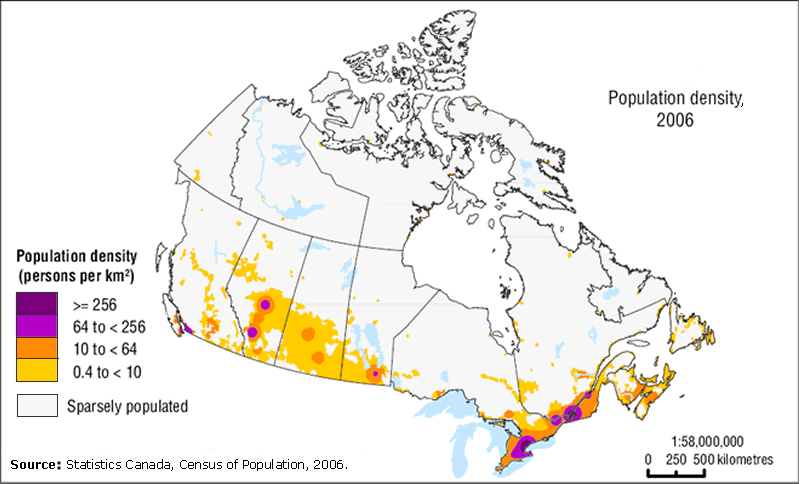
    I don't believe that for one second. Canada is geographically the second largest nation in the world, nearly as big as Russia with a population density of 3.4 people/km^2 versus the EU's 116 people/km^2.
    Quote Originally Posted by Ominous Gamer View Post
    ℬeing upset is understandable, but be upset at yourself for poor planning, not at the world by acting like a spoiled bitch during an interview.

  25. #25


    'nuff said.
    "Wer Visionen hat, sollte zum Arzt gehen." - Helmut Schmidt

  26. #26
    Senior Member Flixy's Avatar
    Join Date
    Jan 2010
    Location
    The Netherlands
    Posts
    6,435
    Sure but almost everybody lives within 100km of the border.

    Edit: too slow
    Keep on keepin' the beat alive!

  27. #27
    RandBlade made a wrong assumtion, population density and centralization have absolutely nothing to do with each other. If there is a statistic correlation between the two it is probably the counter-correlation. There is no country as centralized as Australia.
    "Wer Visionen hat, sollte zum Arzt gehen." - Helmut Schmidt

  28. #28
    I know that stat. Now work out the maths for how big an area 100 miles from the American border is. Hint it is still a ridiculously big area for such a tiny population.

    My in laws town is within 100 miles of the American border. Doesn't stop it from being 4 hour drive to the nearest city and a 2 hour drive from the nearest town.

    Their town and every other town still requires deliveries of perishable fresh goods.
    Quote Originally Posted by Ominous Gamer View Post
    ℬeing upset is understandable, but be upset at yourself for poor planning, not at the world by acting like a spoiled bitch during an interview.

  29. #29
    Quote Originally Posted by RandBlade View Post
    I know that stat. Now work out the maths for how big an area 100 miles from the American border is. Hint it is still a ridiculously big area for such a tiny population.
    Again you wrongly assume that population is evenly distibuted within that 100 miles corridor. It isn't. Look at the maps, a third of the population lives in the 3 largest cities!

    My in laws town is within 100 miles of the American border. Doesn't stop it from being 4 hour drive to the nearest city and a 2 hour drive from the nearest town.

    Their town and every other town still requires deliveries of perishable fresh goods.
    Your in laws are an exception, most Canadians live in Toronto, Montreal, Vancouver and other big cities.

    The urbanization of Northern America is 81% the urbanization of Europe is 73%
    http://www.statista.com/statistics/2...-by-continent/

    Nothing against your in laws but they aren't really representative.
    "Wer Visionen hat, sollte zum Arzt gehen." - Helmut Schmidt

  30. #30
    Quote Originally Posted by earthJoker View Post
    Again you wrongly assume that population is evenly distibuted within that 100 miles corridor. It isn't. Look at the maps, a third of the population lives in the 3 largest cities!


    Your in laws are an exception, most Canadians live in Toronto, Montreal, Vancouver and other big cities.

    The urbanization of Northern America is 81% the urbanization of Europe is 73%
    http://www.statista.com/statistics/2...-by-continent/

    Nothing against your in laws but they aren't really representative.
    Uh. . . what are the numbers with normalized statistics? They say in the abstract there is no common definition used in the study of what "urban" means.
    Last night as I lay in bed, looking up at the stars, I thought, “Where the hell is my ceiling?"

Posting Permissions

  • You may not post new threads
  • You may not post replies
  • You may not post attachments
  • You may not edit your posts
  •