
How's that recession going on your island over there? Your country going to let their arm of a global company like that fail? Would that increase your GDP?Originally Posted by RandBlade


How's that recession going on your island over there? Your country going to let their arm of a global company like that fail? Would that increase your GDP?
Faith is Hope (see Loki's sig for details)
If hindsight is 20-20, why is it so often ignored?
It's like a prisoner's dilemma.... what was the name for it now? I forgot. Theoretically you don't want to do that because then other companies will expect to be bailed out if they make stupid decisions.
And then everyone makes stupid decisions.
It's happened before.. and will happen again...

Moral hazard.
Hope is the denial of reality
Eventually.

Yes long term.
Maybe (and I agree 100% with letting failed firms die; damn the consequences) but I doubt your government has any more power to let that happen than any of the others that have been stymied by the global mega-wealth consolidators.
Anyway, what about the other two questions I asked you?
Faith is Hope (see Loki's sig for details)
If hindsight is 20-20, why is it so often ignored?

Sounds like care-free vacation apathy more than anything else.
Latest reports estimate that $2 billion loss might be double or triple that amount, closer to $5 billion after it's all flushed out. Still a fraction of their overall profits, but that's not the point. And it's not just the media looking for "crisis" news, either. We have plenty of that from EU and middle east nations already, thank you very much.
*Those balance sheets, accounting methods, and synthetic derivatives nearly brought the globally connected financial world to its knees.* It was just a few years ago, have you already forgotten?
We eventually realized that every commercial bank and investment firm had exposure to swap markets, credit-default-swap insurance (mostly in AIG), from London to Iceland. We also learned how vulnerable retirement/pension/mutual and municipal funds were to these toxic financial "tools". Even commercial paper froze up, and money market funds "broke the buck".
All these things can be traced back to those synthetic derivative trading "tools", that were thought to be just another innovative creation of "the markets". Not fully understood, not monitored or regulated in any way, operating in the shadows. That's why they've been called Weapons of Mass Destruction.
Recessions going good, the economy is getting rebalanced which is more important than a recession.
Should be allowed to fail.
Will long term help.
The problem with our short termism politics is that recessions are viewed as a bad thing to be stopped. Recessions are important and useful. You can't control a forest without the occasional fire.
For a minute there, you sounded like Yoda.
There's a problem when people keep calling this a "recession", or a "downturn", or thinking the last few years were just predictable business cycles. Global financial crises aren't just "normal" recessions or business cycles, or the 'innovative' side of capital destruction. We can't ignore that TRILLIONS of personal wealth dollars were destroyed when the housing bubble burst.
And it's hard to understand why you'd think the UK double-dip recession means a rebalancing....when your financial sector remains heavily invested in debt instruments like mortgage-backed securities, or credit-default swaps.
You're right there is a problem when people use the word recession because for most of the time its been incorrectly used and its been just a downturn, not a recession.
We need rebalancing from public sector to private sector, our financial sector is not a problem.
There's nothing intrinsically wrong with mortgage-backed securities or credit-default swaps.
And this latest bout wasn't any ordinary or technical "recession", either. It was either The Great Recession, or a new version of a Depression.
Depends on how you look at the trees in the forest. The financial sector was a huge actor in monetizing debt, especially home debt (mortgages and home equity loans) while trying to make profits by selling the risks of debt to 'investors', and chopping it into smaller pieces as collateralized-debt-obligations.We need rebalancing from public sector to private sector, our financial sector is not a problem.
There's nothing intrinsically wrong with mortgage-backed securities or credit-default swaps.
It's true there's nothing "intrinsically" wrong with debt securities, or insurance products betting on defaults. But when MBSs or CDSs are tied to global finances, and an entity like AIG can threaten to take down several national economies.....it's crazy to say financial sectors aren't part of the problem.

The problem is that when the re-balancing is a bit too severe, you end up with a lot of unemployed, homeless, uninsured, etc., which is a) something I object to, and b) can lead to serious social unrest.
So: in you analogy, you can't control a forest without the occasional fire, but if you burn down the entire forest you will damage or kill most of the ecosystem.
Keep on keepin' the beat alive!
Bull and hysteria. It was nothing like the Depression.
How much % GDP did the USA, UK etc lose in the Depression? How much in this downturn?
US GDP fell dramatically from 1929, 4 years later it was just over half what it previously had been. It took until WWII before the US recovered to 1929 levels.
US GDP fell marginally in this downturn, 4 years on it is already about the same as it was before the downturn started. I believe US GDP is higher now than before the collapse of Lehmans in 2008.
To compare now to the Depression shows a shocking ignorance of what the Depression really was. This is nothing in comparison, absolutely nothing. The Greeks are going through what could be called a Depression, you are not even in recession and haven't been for years.
Unemployment levels in the UK are below now during the recession are below those in France during the previous boom. Unemployment is actually falling currently. The UK private sector has been putting on jobs for the last year, the public sector net losing them. A year ago the public was shedding more than the private were creating (not too bad a problem), now in fact since November the private sector has been creating more more jobs than the public sector is losing. So despite being in a technical recession unemployment is coming down.
Absolutely killing most of the ecosystem is bad, but that's not what we've got.
EDIT for Geegee a couple of graphs. First US GDP highlighting the Depression (the downturn of a few years ago was barely a blip in comparison):
Second unemployment again highlighting the Depression:
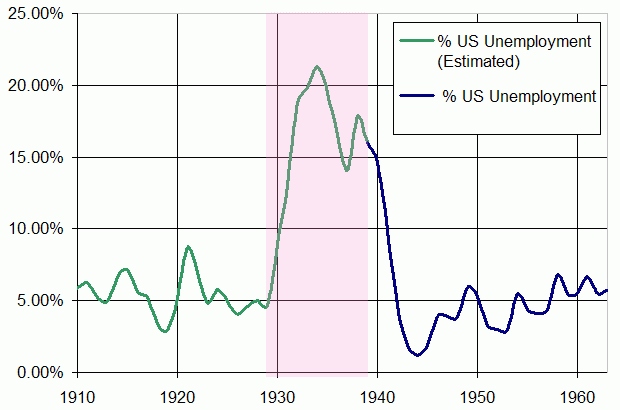
Hope is the denial of reality
That chart shows the weird problems Wikipedia can sometimes have, it claims the recession is still going in one column when it ended 3 years ago in another
Whether you define it as technical recession or NEBR etc its over.
While I don't think you're wrong, RB, the US still has a significant output gap. Also, by postwar recession standards, the drop in GDP has been deeper and longer than any (I think?) other, in most cases by a significant margin.
It might be the worst since WWII, but it pales in comparison to the Great Depression (a 5% loss in output compared to a loss of 27% followed by another 18% a few years later).
Hope is the denial of reality
Agreed; the downturn - recession included - has been very bad, but hardly as bad as that during the Depression. I don't claim otherwise.
I don't doubt that, but comparing it to the Depression is like comparing a bad cold to the Spanish Flu.
One could make a strong argument, though, that the recession could well have been similar to the Depression in scope and magnitude if monetary policy had been the same as in 1929. The Depression was largely the fault of poor monetary policy (too-tight monetary policy coupled with a gold standard); I find it persuasive that this recession shared many traits with the Depression in terms of initial conditions - massive upheaval in global financial markets, huge market players going down in flames, massive deleveraging in the private sector, etc. What distinguishes the Depression from the current economic downturn is not so much the conditions as the response - to take your simile further, both were the Spanish Flu, but one benefited from modern medicine.
I admit that it's tough to prove this thesis - certainly it has been tried, but fundamentally it's hard to know what the world would look like without floating exchange rates, TARP, and QE. I do find it persuasive, though, that things could have been far worse.
I frequently disagree with GGT on issues economic, and I probably don't really agree this time. But she is right about two things: this was not a garden-variety recession, and the 'initial conditions' of this recession did not look too different from the Depression. Obviously it would be a farce to compare the two in terms of effects - the misery of the Depression was far greater than any current gripes (for those in doubt, ask people who grew up during those years). I'm not sure GGT ever claimed that here, though. I do disagree with her about pretty much everything else, though.
No, one really cannot. The conditions are so different, the information available is so superior, the understanding of the economy is so much improved, and the tools available to promote growth are so much more developed that it's inconceivable that GDP could have fallen by a quarter. Hell, Greece is a a total economic wreck and its GDP has only fallen by by about 12-15%.
Hope is the denial of reality
I agree, Loki, but all of those are due largely to macroeconomic control measures. I'll admit that fiscal policy and other things factor in as well - automatic stabilizers like unemployment benefits help, as do regulation on the banking industry (e.g. FDIC, greater reserve requirements, etc.). It's comparing apples and oranges, true, but most economists at the Fed (and elsewhere) believe that the major culprit for the utterly awful depth and breadth of the Depression was monetary policy. There's a clear correlation between exit from the Depression and when each country abandoned the gold standard, etc.
I would argue that without all of the macroeconomic 'levers' we developed after the Great Depression, this most recent crisis and subsequent economic downturn would have been far, far worse... quite possibly on par with our experience 80 years ago. The relevant comparator is understanding the underlying dynamic of financial crises as opposed to run-of-the-mill recessions, and it's clear that this was far greater in magnitude than other financial crises in the postwar era (e.g. Savings & Loan et al). Absent serious gov't intervention, our entire financial system could easily have imploded - every single major bank (except possible JP Morgan?) would likely have fallen, along with a significant portion of foreign banks. Most other financial institutions - insurers, etc. - would probably also have folded. Our world is far more interconnected and far more indebted than the pre-Depression era, and I suspect that the effects would have been severe indeed.
I think this is largely a silly argument because it is comparing apples and oranges, and our economy is so far removed from the economy of 1929. The only worthwhile point is that this downturn does appear to be uniquely bad in the modern era, and that absent gov't intervention it would have been worse. I think we can agree to that, yes?
Back on the topic of recession: good or bad - new figures today show Brits paid down net £118mn on credit cards in April. So it's not just the government, but the public that is rebalancing to a more secure fiscal basis. I view this as a good thing.
I'm not convinced that having some growth caused by adding to credit cards is a reason to smile. The government and public are both acting responsibly, is it any wonder we have a retail spending slump?
Oh, I thought it was because of the zombie epidemic. Zombies don't buy clothes; witness their rags.

Rand, read back to what I actually said. <"And this latest bout wasn't any ordinary or technical "recession", either. It was either The Great Recession, or a new version of a Depression.">
I'm not trying to equate current times to The Great Depression, especially not on the Human Misery Factor. But it's comparable in terms of breadth and depth -- because any other comparison is either a "business cycle", a "normal" recession, or volatility and de-leveraging that comes with every geo-political strife and worry.
No, this last bout since '07 (or early 00's, depending on when you start) was much more than that. It was actually more global, affecting billions of people around the world...because all nations are eminently more inter-connected in financial markets than during The Great Depression. While that was a miserable time for millions of people, it was still an agrarian time when folks had chicken coops in their garage (like my Grandfather), or lived on small farms (like my ex-in-laws, who didn't even have electricity until 1940) and could feed themselves.
The Great Dust Bowl and Grapes of Wraith were real, as were the bank runs and margin calls, and some stock brokers jumped off high-rises when the market crashed. But that was also before 90% of all home "owners" had a mortgage, before the invention of the credit card, and well before most of Main Street had investments on Wall Street. The domino effect was greater, deeper, and more devastating. The flight to safety -- in commodities -- contributed to global hunger.
And it's not over yet. Europe is still in the thralls of what's being called a slow motion Depression. GDP has become a practically useless tool, unless it's put into context with other variables that include the lives of real people.
This is a bit out of place in the thread, but also very relevant.
http://www.marketwatch.com/story/ban...vestinginsight
Commentary: Even children know not to do what banks do
Makes sense. Of course, as a retail business owner, you'll have to hope your business won't suffer as people cut down on "non-essential" expenses, whether they've been using credit or cash. Right?

There is no "too big to fail" but "too big to succeed".
Raoul Pal expects a series of sovereign defaults, the "biggest banking crisis in world history", and asserts that we don't have many options to stop it.
Former Hedge Funder Presents A Terrifying Vision Of THE END GAME
http://www.businessinsider.com/raoul...me-2012-6?op=1
Freedom - When people learn to embrace criticism about politicians, since politicians are just employees like you and me.
No, not just hope but act accordingly: provide value to customers, cut costs where we can without cutting quality etc
If your companies not good enough to survive it should fail. Problem is government doesn't (until now in Greece) face that pressure.
It is pressure to succeed not fail that makes capitalism work.
The problem with Greece is that they have been under speculative attacks on Greek bonds to raise premiums, according to Greek intel which identified american financial entities behind the attacks, so they have to pay more to borrow money. So it is a crisis that has been artificially created. Initially Greece had a high debt because they bought weapons to France and Germany, but bailouts made things worse, as govt borrowed money to bailout banks, worsening its debt.
Merkel called "market extortion" the attempt of big investors to force risk premiums up for PIIGS.
As a condition to lend money, lenders are asking to cut govt spending, which is a recessive move, as government is a valve of liquidity for the economy, so it reduces liquidity, making companies to go bankrupt and people to become unemployed and poor. So in the end Greece collects less and less taxes with the govt spending cut. Also, when they talk about Greek bailout indeed they are bailing banks out, not people. So banks get an injection of money, government that had lots of debt gets more debt, and people become poorer and more unemployed.
The case of Spain is another facepalm, a political one. Spain had a recession, so DSK frmo IMF had the wonderful idea of suggesting Zapatero to lend money to "stimulate" economy, and what they did was to subsidize failed banks and companies that should have go bankrupt. This is where the debt crisis came from.
On top of that they reduced the cost of firing people, so it is easier to fire people and worsen the already bad unemployment crisis. Also it reduced govt wages and fired people. The problem of Spain is that it lacks consumers, so companies cannot thrive, and with every move, government is worsening the crisis. Rajoy was seen as a new hope, but he came just to make things worse, as health and education are suffering cuts. So companies are firing, government is firing, so unemployment and consumtion goes down. So it seems like Zapatero and Rajoy wanted Spain to become a "banana monarchy" and they are succeeding. Now, instead of helping consumers, they keep helping failed banks and companies.
Spain is one place where you may find some of the cheapest workers in western Europe, and still OECD says spanish people have "low productivity", which makes people think they are lazy. Indeed I read the report and I realized that they were talking about production, not productivity. Production went down because there were no customers/consumers because of the massive firing of people. So companies had nobody to sell their products. So you had idle capacity and lower GDP, and OECD calls that "lower productivity" which makes people think that spanish are lazy. Indeed Spanish work more extra time than many countries in Europe, as those who still have a job accept low wages for extra long working days. Spain could have recovered if they had started to implement a New Deal, but they are doing exactly the opposite. I would have fired those OECD people who made that report as it was BS.
On top of that, spanish banks are so greedy that they are not accepting houses as payment for the debt (dación de pago), but they take borrower's house and make it worth in books for half of its value, so when people lose their jobs, in the end people lose their homes and still have a mortgage to pay which will be piling up interests. The 15M (sort of OWS in the US) has been asking for dación de pago but politicians do not listen.
Freedom - When people learn to embrace criticism about politicians, since politicians are just employees like you and me.
 Posting Permissions

 Reply With Quote

