Results 1 to 12 of 12

Thread: Family Cancer

  1. #1

    Default Family Cancer

    Over the past few weeks, someone in my immediate family was diagnosed with cancer. A rapid surgery was arranged and a very small tumor was successfully removed last week.

    Today we got the post-op results and overall they (plus the pre-op MRI) have been good -- Stage 1, clean margins, no detected spreading. The only hiccup is the tumor itself had a lot of protein receptors on it, which basically means it was primed to kick into high gear and grow quickly when prompted by something common in our bodies. Translation: the post-operation steps are critical to preventing a recurrence, because if any cancer cells are left they could rapidly grow.

    The next step is post-op radiation and treatment with a relatively successful drug that targets this specific protein. This has all moved so fast that a lot of it hasn't sunk-in for a lot of us. One of the frustrating items for my family member is a lot of the literature about this particular drug touts the high disease-free survival rate relative to non-treatment. But that's just a relative rate, not an underlying survival rate with treatment.

    So I dug deep into as much material as I could find to see that the 5-year disease free rate is basically 10%. I have a gut response here, but I'm curious to know if people think I should be passing-along this info to my immediate family member. 10% sounds low, and I have no idea if it's actually low. Getting my family members to stay positive is a priority, and I'm 100% sure this knowledge won't change their course of action because they are definitely doing this treatment (and it has very low likelihood of bad side effects).

    So what do people think?

  2. #2
    Sorry to hear about the cancer and fingers-crossed.

    As for your question: No. Let the doctors and experts pass on the information, they know best. One of the problems it seems nowadays with Google is that everyone seems to be an "expert" and often its BS/misunderstood - sometimes upsettingly so.
    Quote Originally Posted by Ominous Gamer View Post
    ℬeing upset is understandable, but be upset at yourself for poor planning, not at the world by acting like a spoiled bitch during an interview.

  3. #3


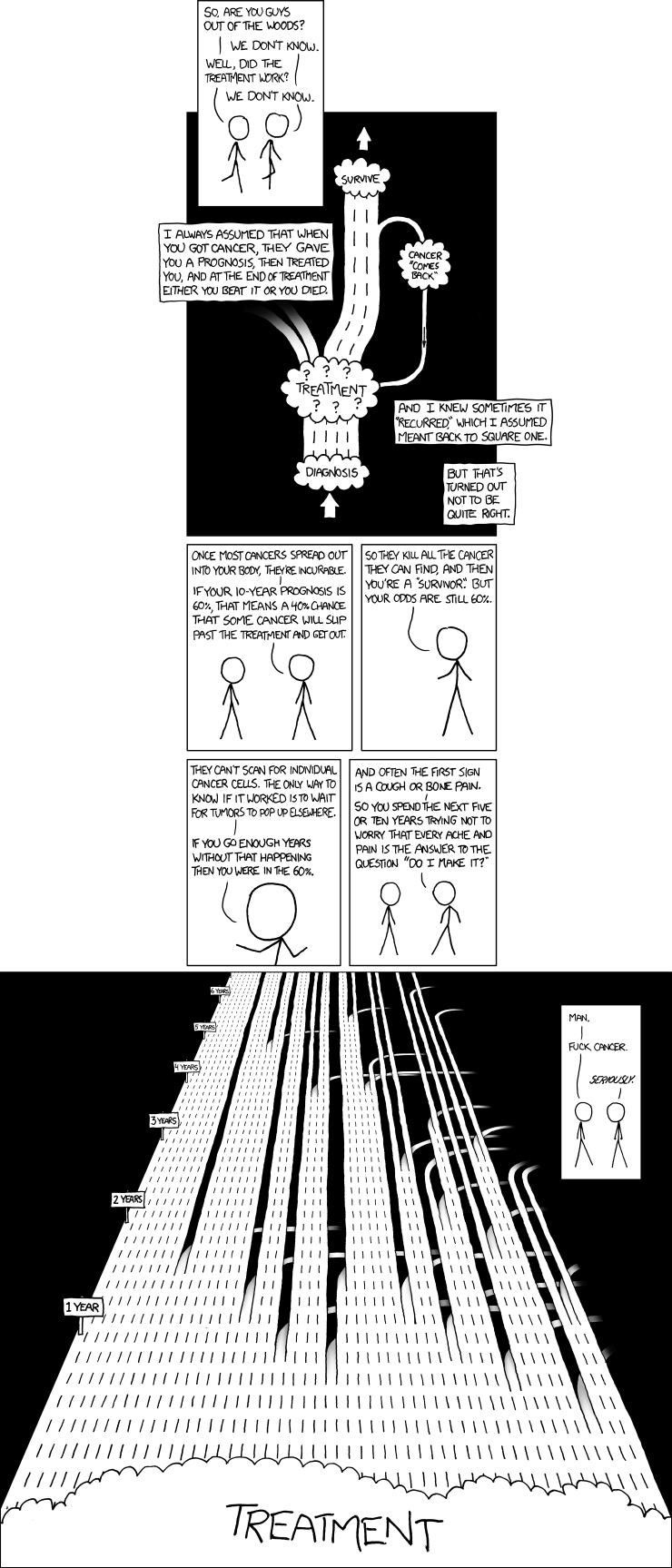
    after my dad died from cancer, and my mom was diagnosed...xkcd published this and I showed it to my mom at her first radiation session. You shouldn't act like you don't know. You can bet the doctors already told them their true chances, even if they haven't passed that on to you. The more honest and open everyone is, the easier it is to accept whatever comes, and to enjoy everything in between.
    "In a field where an overlooked bug could cost millions, you want people who will speak their minds, even if they’re sometimes obnoxious about it."

  4. #4
    Quote Originally Posted by Dreadnaught View Post
    Over the past few weeks, someone in my immediate family was diagnosed with cancer. A rapid surgery was arranged and a very small tumor was successfully removed last week.

    Today we got the post-op results and overall they (plus the pre-op MRI) have been good -- Stage 1, clean margins, no detected spreading. The only hiccup is the tumor itself had a lot of protein receptors on it, which basically means it was primed to kick into high gear and grow quickly when prompted by something common in our bodies. Translation: the post-operation steps are critical to preventing a recurrence, because if any cancer cells are left they could rapidly grow.

    The next step is post-op radiation and treatment with a relatively successful drug that targets this specific protein. This has all moved so fast that a lot of it hasn't sunk-in for a lot of us. One of the frustrating items for my family member is a lot of the literature about this particular drug touts the high disease-free survival rate relative to non-treatment. But that's just a relative rate, not an underlying survival rate with treatment.

    So I dug deep into as much material as I could find to see that the 5-year disease free rate is basically 10%. I have a gut response here, but I'm curious to know if people think I should be passing-along this info to my immediate family member. 10% sounds low, and I have no idea if it's actually low. Getting my family members to stay positive is a priority, and I'm 100% sure this knowledge won't change their course of action because they are definitely doing this treatment (and it has very low likelihood of bad side effects).

    So what do people think?
    First off, I'm very sorry to hear about your family illness. There's not much we can do here to help, but if there is anything, please let us know.

    I won't tell you what to do but I do want to urge caution in your interpretation of the data. I do not want to malign your analytical skills, but there are a lot of subtleties in accurately assessing such data (and research) that the lay person may not be able to fully grasp. Major caveats to the 10% 'cure rate' you saw - it may apply to a larger population than the specific circumstances surrounding your relative's disease. As such, the particular variant may be more or less 'curable' depending on the details of the case. Secondly, all of these studies are perforce retrospective in nature. Cancer treatment is improving rapidly (for some kinds, at least), meaning that historical data - even seemingly 'recent' data - may not be indicative of future results. Thirdly, even a fairly low cure rate of 10% (which is not terrible but certainly not good as cancer goes) does not mean 90% of people die in 5 years; it merely means they are not seemingly disease free - nor does it rule out the possibility of a future 'cure', though obviously the odds get worse the longer the cancer is around.

    The tricky question of what information to share is tough. On the one hand, it's not really your responsibility to do so - a qualified medical professional can almost certainly give better context than you, and it's not unreasonable to trust them with the course of treatment - both physical and mental. That being said, I tend to favor openness provided there are no likely downsides associated with such information sharing. The big concern to me would be that it would discourage/depress your relative, leading to complications in treatment (you'd be surprised how much patient attitude is relevant to a successful treatment regimen). If, however, your relative is unlikely to have this reaction, perhaps a frank discussion would be in order.

    Lastly, I want to urge you to realize that while statistics are certainly indicative of a basic trend, it is hardly a death sentence. I have a relative who was diagnosed with stage III renal cell carcinoma back in... 2006? 2007? and is still alive and kicking (though most certainly not disease free). Cancer is a nasty disease, but it is possible for people to live for a surprisingly long time even with pretty scary diagnoses.

  5. #5
    Sorry to hear about the shock of this sudden news Dread.

    Not much to say, 'cept this sounds familiar of my father's bowel cancer. Was caught early, operated on successfully, treated immediately after with several chemo sessions, and he is now completely clear, has been for a number of years, and has an annual checkup to make sure he remains completely clear.

  6. #6
    Thank you for all the nice wishes and ideas. Based on some of the feedback here and with some other people, I think I'm going to focus on nudging my family member to ask specific questions.

    Separately, I'm going to encourage them to take the time to actually write out a list of things they want to do in life but have sorta put off (this person is older and semi-retired). And encourage them to see a therapist to talk about this stuff -- we're both similar in that we like routine/continuity and compartmentalize things that fit outside of our routines. So they really need someone outside of the usual circle to vent outside of the usual ways.

  7. #7
    Sorry to hear this, Dread.

    wiggin shared a wealth of wisdom, well worth heeding.

    My only "input" would be asking more questions that maybe you're not comfortable answering. It matters if your relative is male or female, young or old, previously healthy or chronically ill. (You'd probably think of me as 'older and semi-retired', too....but that could mean another 20-30 years left to live, even with a chronic illness).

    It matters if the primary cancer is breast, uterine, ovarian, testicular, prostate...

    Assuming your relative is receiving top notch care, some type of talk/group therapy or counseling will likely be involved. If their primary physician is worth their salt, they'll be referred for dealing with things that fall outside of regimented/planned life, and its surprises (regardless of their oncologist's abilities). Compartmentalization, as a coping mechanism, doesn't work so well with cancer diagnoses.

    Cancer isn't the death sentence it used to be. More often than not, it's considered a chronic illness, with flare-ups between remission periods, that can be managed, if not cured. I hope that brings some hope to you and yours.

  8. #8
    Well, one thing (to address Wiggin's post a bit) is that we had some hope that there wouldn't be any chemo involved. One of the things I was reluctant to share with my relative was that all the clinical trials I read suggested that this drug had only been tested with chemo.

    As Wiggin said, I have a reasonable amount of bio background but I'm certainly no doctor so I sat on this. After all, maybe there's a treatment that doesn't involve chemo considering how early this was found.

    Today the doctor called (while on vacation/weekend at their Florida condo, how nice!) to follow-up as well as answer any questions and we got the confirmation that chemo is mandatory. The reason boils-down to the specific aggressiveness of the cancer. I've offered to shave my head in solidarity (or let the kids shave both of our heads to help explain to them what's going on), but we'll cross that road when we get there in about 3-6 weeks.

  9. #9
    Dread, is there some reason you don't want to say what type of cancer this is? Or what you mean by "chemo"?

    Tamoxifen is a "chemotherapy" agent....but it's used in pill or gel form. Many new "chemo" treatments don't mean IV infusions, let alone hair loss or weight loss, which is what most people think of.

  10. #10
    Call me a Yurp, but because of privacy. But the chemo apparently will lead to hair loss.

  11. #11
    I'm sorry to hear this, Dread, and I hope you guys are doing as well as you can under the circumstances and getting any support and guidance you may need.

    Re. the questions you ask, the honest truth is that, although we've made progress in the treatment of cancer, some new and sophisticated cancer drugs do really only offer modest absolute benefits in many of their intended populations. Nevertheless, I would be wary of bringing up these conerns with the patient and his/her partner. Jeopardising their hope when they intend to go through with the treatment anyway--esp. if they've been thoroughly informed by their doctor and feel the expected side-effects are acceptable--may not be the right thing to do. More optimistically, it is possible that the patient may belong to a subpopulation--whether biologically or karmically defined--in which the suggested treatment is expected to be more successful than you are led to believe from reading the study-results.

    If you really would like to know the numbers, and only if the option is available to you, ask the oncologist or another oncologist in general terms about reasonable and unreasonable expectations and perspectives.
    "One day, we shall die. All the other days, we shall live."

  12. #12
    Well, we pushed a bit on the numbers in the oncologist meeting and they weren't super discouraging. Nonetheless, chemo starts next week and hair loss a bit after that.

Posting Permissions

  • You may not post new threads
  • You may not post replies
  • You may not post attachments
  • You may not edit your posts
  •